Landscaping Steep Backyards for Safe Garden Access
Got a steep backyard? Learn how we add safe access paths, small retaining walls, and remove old T-posts to turn tricky slopes into usable garden space.
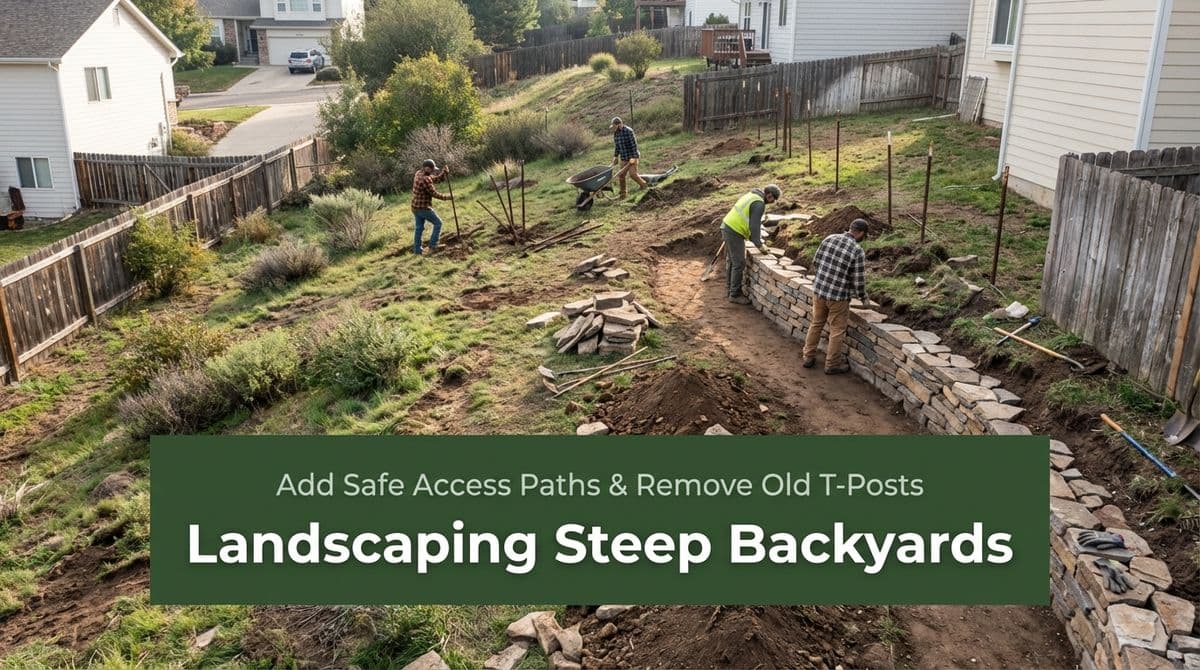
Turning a Steep Backyard Into a Safer Garden Space
We recently got a call from a customer — let’s call her Emily — who had been gardening on a pretty steep backyard for a couple of years. She’d just cleared a new area and wanted to make it easier (and safer) to walk from the lower part of the yard up into the garden. On top of that, she thought she might need a small retaining wall and had “about a dozen and a half” old T-posts that needed to be pulled out.
Calls like Emily’s are common for us. Steep yards can absolutely become beautiful, usable gardens, but they do take a bit of planning. In this post, we’ll walk through how we typically approach projects like Emily’s: assessing the slope, designing safe access paths, deciding where small retaining walls make sense, and dealing with old T-posts.
Step One: Assessing the Slope and How You Use the Space
When we meet a homeowner like Emily, we start with two simple questions:
- How steep is the slope? Is it just a little awkward to walk on, or do you feel like you’re going to slip every time it rains?
- How do you actually use the space? Is it mostly garden beds, lawn, pets, or kids running around?
For most backyards, we’re thinking about three things right away:
- Safe foot traffic: You should be able to carry tools, soil, or a basket of veggies without feeling off balance.
- Erosion control: Steep slopes wash out quickly, which can ruin garden beds and expose roots.
- Drainage: Water needs a predictable path so it doesn’t pool near the house or in the garden.
Once we see how you move through the yard, we can start laying out logical access routes — where a path should run, where steps are needed, and where a small wall might help flatten a planting area.
Designing Safe Access Paths on a Steep Backyard
For Emily, the priority was getting safely from the low area up into the garden. On slopes, we rarely run a path straight up and down; it’s usually more comfortable to zigzag or curve across the slope to reduce the steepness you feel underfoot.
Basic guidelines we use for garden paths
- Width: We like at least 36" wide for garden access so you can carry tools or a wheelbarrow. In tight spots, 30" can work if it’s just foot traffic.
- Surface: Crushed rock, decomposed granite, pavers, or stepping stones set into compacted gravel all work well. Grass on a steep slope tends to get slippery.
- Traction: On steeper sections, we add steps or mini landings to break up the slope so your foot has a flat place to land.
In a yard like Emily’s, a path might start at the lower lawn, switchback once or twice, and connect to the main garden beds with short steps at the steeper parts.
When we recommend actual steps
If you feel like you need to lean forward to walk up, or you slide a little going down, we’ll often add steps. We usually aim for:
- 6–7" risers (height of each step)
- 12–16" treads (depth of each step so your whole foot fits)
Materials can match your style and budget: timber, natural stone, or precast concrete blocks. For many gardens, simple timber risers with gravel treads are a cost-effective, natural-looking option.
Where Small Retaining Walls Make a Big Difference
Emily mentioned she “might need a little bit of a retaining wall.” That’s something we hear a lot, and the key is understanding when a wall is actually helpful versus when grading and paths are enough.
Good uses for small retaining walls
- Creating flat planting terraces: Even a 12–24" wall can turn a frustrating slope into a level, easy-to-work garden bed.
- Supporting edges of paths or steps: A short wall can hold back soil so your path doesn’t slowly creep downhill.
- Stopping erosion below garden beds: A low wall with a gravel backfill lets water drain while keeping soil in place.
For many homeowners, one or two short walls, combined with better access paths, transform the whole backyard without the cost of a major hillside rebuild.
Key things we watch for when building small walls
- Drainage: We leave weep gaps or use perforated pipe and gravel so water doesn’t build up behind the wall.
- Setback and base: Segmental block walls get a compacted gravel base and a slight backward lean into the slope for stability.
- Height limits: Once a wall gets over a certain height (often around 3–4 feet, depending on conditions), engineering and permits may come into play.
On a project like Emily’s, we might only need a low wall to create one flat working area and support the uphill side of a path.
Removing Old T-Posts Safely
Emily also had roughly a dozen and a half old T-posts to remove. These posts are great for temporary fencing, but once you’re ready to clean up and re-landscape, they’re a trip hazard — especially on a slope.
How we typically pull T-posts
We usually use a post puller or leverage tool so we’re not just yanking by hand. If you’re tackling a few yourself, basic steps look like this:
- Check stability: Wiggle the post to see how solid it is and make sure there aren’t hidden wires or buried utilities nearby.
- Loosen the soil: Water the area or gently dig around the base if the ground is rock hard.
- Use leverage: A jack, puller, or even a sturdy board against a block can give you mechanical advantage to lift the post straight up.
- Backfill holes: Fill and tamp the hole so you’re not left with ankle-twisting voids in the yard.
On a steep property, we also plan how to carry the posts out safely and where to stack them so they’re not rolling downhill.
Putting It All Together for a More Usable Garden
For a backyard like Emily’s, our finished plan usually includes a few key pieces working together:
- A clear, non-slip access path from the lower yard to the main garden
- Steps in the steeper sections, sized for comfortable everyday use
- One or two small retaining walls to create flat, easy-to-work garden terraces
- Safe removal of old T-posts and clean backfilling of all holes
The result is a space you can actually enjoy: you’re not sliding down the hill with a watering can or avoiding parts of your yard because they feel unsafe.
If you’re looking at your own steep backyard and wondering how to make it more usable, we’re happy to take a look. We can walk the slope with you, talk through access, walls, and T-post removal, and put together a plan that fits the way you actually garden.